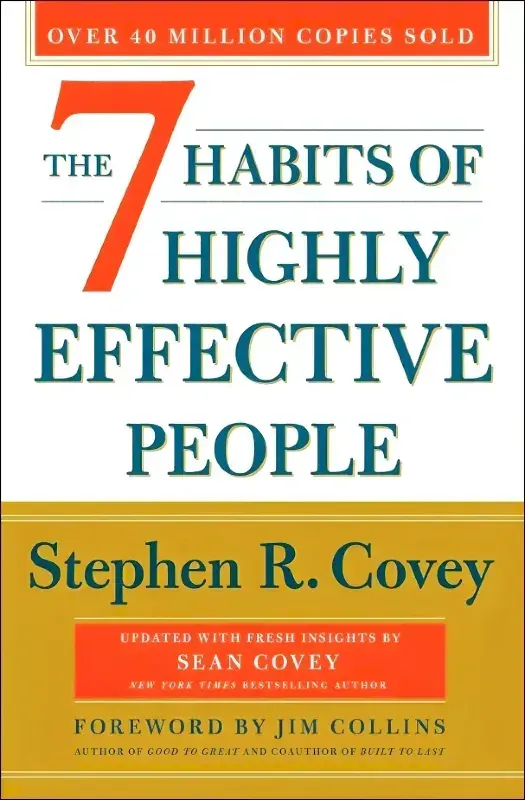
The 7 Habits of Effective People - Stephen R. Covey
Real change begins within me. When we act with intention, discipline and empathy, we can build trust with others and achieved long lasting success through continuous learning and self caring.

🚀 The Book in 3 Sentences
- We achieved private victory when we chose being proactive, begin with the end in mind, and put first thing first.
- We achieved public victory by thinking win-win situation, understand others before being understood and synergising with others.
- Renewal happens when we perform 'sharpen the saw' activity, through physical, mental and spiritual act such as working out, reading and perform prayer.
🎨 Impressions
I really enjoyed this book because the author leads by example showing humility and empathy in his everyday life especially in how he treats his children and the people around him. It made me reflect on how I show up when I try to influence others whether to get things done or to help them see things differently and it reminded me that empathy always comes first.
One of the most powerful lessons for me was realizing that meaningful change starts within myself. The way the book is structured made this easy to understand. The book begins with private victories which focus on building discipline and clarity within myself before moving into public victories which focus on building trust and cooperation with others and finally ending with self renewal.
The book showed me that achieving meaningful progress is not about doing everything but about being proactive and having clear intentions and focus on what truly matters. Once that inner foundation is strong it becomes easier to create public victory by seeking win-win situations and taking the time to truly understand them. Real synergy grows when we take the action of getting to know each other interest, hopes, goals, and their paradigm and this will turns mutual respect to synergising communication.
The idea of sharpening the saw was a powerful reminder that growth requires renewal. Replenish myself through exercise, reading and prayer helps me to stay balanced. Overall this is a life changing book that I know I will revisit because its lessons are simple practical and deeply relevant to how I want to live my life.
📀 How I Discovered It
I believe I first downloaded this book as part of a free trial and did not think much of it at the time. The real push that got me to finally read it came later when Ali Abdaal mentioned it in one of his videos and spoke about its impact.
🦉 Who Should Read It?
Anyone who has not read this book is likely missing out on one of the life changing reads they could experience. It offers lessons in empathy and serves as a clear example for anyone who wants to live a more meaningful life and build deeper, stronger relationships.
☘️ How the Book Changed Me
- I am what i repeatedly do. Excellence is not an act but a habit.
- My character is composite of my own habit.
- I recognise emotionally interdependent is in the form of love, the need of love, giving and receiving love from others.
- My character all stems from my decision. Making and executing the right decision can change the course of my life.
- Controlling the response instead of the reaction.
- Opportunity comes for whom act on it.
- I choose to be proactive, my work is driven by my values, not feelings.
- I choose to be resourceful, diligent, creative, and cooperative.
- Produce my own mission statement to seek clarity and lead a meaningful life.
- Being effective is being opportunity minded people.
- Not to prioritise my schedule but schedule my priorities.
- Treat people with trust because its the highest form of motivation.
- Always think win win to ultimately win.
- To do well is to help others instead of focusing on helping myself only.
- Principle are my natural laws, external to me and ultimately control the consequences of my action.
- Values are internal and subjective and represent that which i feel strongest about in guiding my behaviour.
- Values govern my behaviour, principles governs the consequences of my behaviour.
- Build my relationship around people through trust and openness
✍️ My Top Quotes
- Your attitude determines your altitude.
- We see the world, not as it is, but as we are -- or, as we are conditioned to see it.
- We are what we repeatedly do. Excellence, then, is not an act, but a habit.
- Sow a thought, reap an action; sow an action, reap a habit; sow a habit, reap a character; sow a character, reap a destiny.
- You can buy a person's hand, but you can't buy his heart. His heart is where his enthusiasm, his loyalty is. You can buy his back, but you can't buy his brain. That's where his creativity is, his ingenuity, his resourcefulness eventhough the decision was a meere of waking up 30 mins early.
- My friend, love is a verb. Love -- the feeling -- is a fruit of love the verb. So love her. Sacrifice. Listen to her. Empathize. Appreciate. Affirm her. Are you willing to do that?
- Proactive people aren't pushy. They're smart, they're value driven, they read reality, and they know what's needed.
- Management is doing things right; leadership is doing the right things
- Succeed at home first.
- The successful person has the habit of doing the things failures don't like to do and the power to do something when you don't want to do it.
- The challenge is not to manage time, but to manage ourselves.
- Effective people are not problem-minded; they're opportunity-minded.
- The enemy of the "best" is often the "good.”
- It is the weak who are cruel. Gentleness can only be expected from the strong.
- The heart has its reasons which reason knows not of.
- Seeking to understand requires consideration; seeking to be understood takes courage.
- Almost all the benefit of the exercise comes at the very end.
- The person who doesn’t read is no better off than the person who can’t read.
- Character cannot be made except by a steady, long continued process.
- To be thoroughly used up when I die.
- Treat a man as he is and he will remain as he is. Treat a man as he can and should be and he will become as he can and should be.
- You may think you don’t have time to exercise, go to lunch with a friend, read a book, write in your journal, attend that conference, take a break, or go on a family vacation. In reality, you don’t have time not to.
- You can go home again—if your home is a treasured relationship, a precious companionship.
- That which we persist in doing becomes easier—not that the nature of the task has changed, but our ability to do has increased.
- We are not human beings having a spiritual experience. We are spiritual beings having a human experience.
- What is common sense is not always common practice.
- People don’t care how much you know until they know how much you care.
- No success can compensate for failure in the home.
- Retirement is a false concept. You may retire from a job, but never retire from meaningful projects and contributions.
- In relationships, the little things are the big things.
📒 Summary + Notes
Part One: Paradigms and Principles
- Constructive feedback is consisting of sharing my opinion and offering solution for change.
- Having deep integrity, fundamental character strength can influence people to work better, make people motivated and can also influence people to do what i want to do.
- What i am is more than anything i said or do.
- We trust some people absolutely because we know their character even though they are not eloquent or they have poor human relations technique.
- What is paradigm?
- It is a theory, an explanation or a model of a certain aspect similar like a map.
- People have 2 kind of maps in their heads.
- Map of the way things are (realities)
- Map of the things should be (values)
- Changing attitudes and behaviour is changing the basic paradigm from which these attitudes and behaviour roots at.
- Being aware of my own paradigm makes me responsible for questioning what shapes my thinking and checking whether it truly reflects reality.
- We have a truth of thing as they are when we value correct principle.
- There are times to teach and not to teach.
- When relationship are strained, an attempt to teach is perceived as a form of judgement and rejection.
- Instead, bring the person/child alone quietly when the relationship is good to discuss the teaching or the values.
- Our character is a composite of our habit.
- Create habit to create order, cohesiveness which leads to effectiveness in our live.
- Good habit reduces procrastination, impatience, criticalness and selfishness.
- What is habit?
- Intersection of knowledge, skill and desire.
- How to form habits?
- Knowledge is the theoretical paradigm.
- Skills is the how to do.
- Desire is the motivation.
- Incorporate all three to form a habit.
- Independent people may be a good individual producers but if they're not coming from interdependence paradigm, they wont be a good leaders or team players.
- Interdependence is more mature and advance concept. People can accomplish more than ever interdependently compare to personal independent act.
- Emotionally interdependence to a safe degree drive a great sense of worth within myself and this makes me recognise the need of love, giving and receiving love from others.
- Energies of the mind and heart;
- Mind: creativity, ingenuity and resourcefulness comes from.
- Heart: root of enthusiasm and loyalty.
Part Two: Private Victory
- Consist of;
- Be proactive.
- Begin with the end in mind
- Pur first thing first.
- Habit of public victory unleash desire and the resource to heal and rebuild important relationship becoming solid, deeper, creative and more adventuresome.
Habit 1: Be Proactive
- I'm not my feelings, I'm not my moods, I'm not even my thoughts. Self awareness enables me to examine my own paradigm.
- There are 3 social maps/paradigm
- Genetic determinism: what my grandparents did to me such as temper in my dna.
- Psychic determinism: what my parents did to me, upbringing and childhood experience.
- Environmental determinism: some or something in my environment that is responsible for my action.
- What is proactivity;
- I am responsible for my own life. My behaviour is a function of my decision, not conditions.
| Reactive person | Proactive person |
|---|---|
| People who are driven by feelings, circumstances, conditions and environment | People who are driven by values (carefully thought, selected and internalised values |
| Love is a feeling | Love is a verb - something that i do, sacrifices, giving of self |
| Focus their effort on circle of concern. Focusses on weaknesses in people, problems in the environment, problems that they can't control. Blaming, accuse and empower self victimisation | Focus their effort in the circle of influence. Works on something that they can control, their energy is positive, enlarging and magnifying. |
| Blind to other people weaknesses. | Anticipated, empathised and read the situations. Compensate other weaknesses by working with their strength. |
| Not pushy, smart, value driven, read reality and know what’s needed | |
| Resourceful, diligent, creative, cooperative. |
- The situation does not change me, however response to the situation does.
- Challenges may hurt me physically/economically but it doesn’t hurt my character.
- 3 central values in life
- Experiential: things that happens to us.
- Creative: things we brings into existence.
- Attitudinal: response to a particular circumstances.
- High performing people are proactive, provide solutions, seize the initiatives, consistent with their principles and get the job done.
- Tips handling children;
- When my kid take irresponsible action/position and waits for someone else to provide solution, tell them “use your resourcefulness and initiative”
- Language is the indicator of proactivity;
- Reactive people language free them from responsibility.
- “I have to do it” - language of people being forced and do not have freedom to choose action.
- Love is feeling.
- Proactive people make them responsible
- “I can choose different language, I control my feelings, I choose, I prefer, I will”
- Love is a verb.
- Love is value, brought into existence through loving actions.
- Proactive people subordinate feelings to values.
- Reactive people language free them from responsibility.
- If we let our feelings controls our action, it means that we empowered our feeling to let it do so and we set ourself free from responsibility.
- My proactivity can also be determine through how I focus my energy and time.
- Type of problems we face.
- Direct control - problem involving our own behaviour.
- Indirect control - problems involving other’s people problem.
- No control - problems we can’t control.
- Proactive people act on what he can control.
- Proactive executive
- Do more what was expected.
- Anticipated the leader’s need.
- Emphasised with leader underlying concern.
- Gave information, with additional analysis and recommendation.
- Did not threaten leaders, complemented his strength, and compensated weaknesses.
- Response-able: to control my life, influence circumstances by working on it and be on what we are.
- Make and keep commitments to myself is the essence of effective habits.
- Look at weaknesses with compassion.
Habit 2: Begin with the End in Mind
- I gain different perspective when employing begin with the end in mind.
- Example of begin with the end in mind
- Raising a disciplined, responsible, children requires me to not undermine self discipline or self esteem.
- Business fails because undercapitalisation, misunderstood the markets or lack of business plan.
- Management is bottom line focus
- Leadership is top line focus (what are the things I want to accomplish)
- Parenting tips
- Do not be trapped in management paradigm, thinking about control, efficiency and rules.
- Instead thought our children of direction, purpose and family feelings.
- My personal live shall be determined by my personal leadership such as following my own values instead of focusing my living by managing with efficiency, setting and achieving goals only.
- What i want my kid out of me.
- I want her life to represent teaching, training and discipline with love over a period of years instead of battle scars from quick fix skirmishes.
- I want her heart to be filled with pleasant memories of deep, meaningful times together.
- I want her to remember me as loving father who shared the fun and pain of growing up.
- I want her to remember the times she came to me with her problems and concerns.
- I want to let her know that I wasn’t perfect but I have tried with everything i had.
- I want to let her know that more than anybody in the world that I loved her.
- Personal mission statement is unique both in content and form. Such example
- “Succeed at home first”
- Never compromise honesty.
- Hear both sides before judging.
- Defend those who are absent.
- Be sincere yet decisive.
- My own mission statement;
- Develop 1 new proficiency a year.
- Plan tomorrow's work today.
- Hustle while I wait.
- Maintain a positive attitude.
- Keep a sense of humour.
- Be orderly in person and work.
- Do not fear mistake, fear the absence of creative, constructive and corrective response to the mistake.
- Facilitate my subordinate success.
- Listen twice as much as you speak.
- Concentrate all abilities and efforts on the task at hand, and not worrying about the next job or promotion.
- Example of working mom mission statement;
- Seek to balance my family and career since both are important.
- My home will be a place where me, my family, friends and guest find joy, comfort, peace and happiness.
- Create a clean and orderly environment yet liveable and comfortable.
- I will exercise wisdom in what i choose to eat, read, see and do at home.
- I want to teach my children to love, to learn, to laugh, to work and develop their unique talents.
- I value the rights, freedom, and responsibilities of our democratic societies.
- I will be a concerned and informed citizen, involved in political process to ensure my voice is heard and my vote is counted.
- I will be a self starting individual who exercise initiative in accomplishing my life’s goals.
- I will act on situations and opportunities rather than to be acted upon.
- I will keep myself free from addictive and destructive habits
- I will develop habits that free me from old labels and limits and expand my capabilities and choices.
- My money will be my servant, not my master.
- I will seek financial independence over time.
- My wants will be subject to my needs and my means.
- I will seek to keep myself away from consumer debt.
- I will spend less than i earn and regularly save or invest part of my income.
- I will use the money and my talents to make life more enjoyable for others through service and charitable activities.
- Type of alternative centers
- Spouse centeredness
- Family centeredness
- Money centeredness
- Work centeredness
- Possesion cenferedness
- Pleasure centeredness
- Friend/enemy centeredness
- Self centeredness
- Principle centeredness
- Good affirmation
- Personal
- Positive
- Present tense
- Visual
- Emotional
- Ex; It is deeply satisfying (emotional) that I (personal) respond (present tense) with wisdom, love, firmness, and self-control (positive) when my children misbehave.
- My mission is to live with integrity and to make a difference in the lives of others. To fulfil this mission;
- I have clarity: i seek out and love everyone; each one regardless of his situation.
- I sacrifice: i devote my time, talent and resources to my mission.
- I inspire: i teach by example that we are all khalifah and that every goliath can be overcome.
- I am impactful: what i do makes a different in the lives of others.
- This roles is important to achieve my mission.
- Husband: my partner is the most important person in my life. Together we contribute the fruits of harmony, industry, charity and thrift.
- Father: I help my children experience progressively greater joy in their life.
- Son/brother: I am frequently there for support and love.
- Muslim: God can count on me to keep my contract (solat) and to serve other children.
- Neighbour: I take care of my actions towards others.
- Change agent: I am the catalyst for developing high performance in organisation.
- Scholar: I learn important new things everyday.
- How to a have an effective mission statement and ensure people can follow through. Ask this question below;
- How many people know that I have a mission statement.
- How many people know what it contains.
- How many were involve in creating it.
- How many really buys into it and use it as my frame of making decision.
Habit 3: Put First Things First
- Discipline comes from disciple
- Disciple to a philosophy
- Disciple to a set of principles
- Disciple to a set of values
- Disciple to an overriding purpose / superordinate goal / a person who represent that goal.
- Effective manager of my self means that discipline comes from within.
- Organise and execute around priorities.
- The best time management action is to organise and execute around priorities.
- Time management according to the generations build on one before it.
- First generation: characterised by notes, checklist, an effort to give appearance of recognition and inclusiveness to the many demands placed on our time and energy.
- Second generation: characterise by calendars and appointment books.
- This action is an attempt to look ahead, to schedule events in the future.
- Third generations: characterised by the current time management field.
- Prioritisation of important ideas, values clarification, comparing activities based on the relationship of values.
- It involve with setting goals to which time and energy would be directed with values.
- It also include daily planning of specific plan on how to accomplish stated goals/activities deems worthy
- Fourth generation: focus on preserving and enhancing relationship and accomplishing result by maintaining the P/PC (production and production capability)
- What is importance: importance is related to results, it contributes to my mission, values and high priority goals.
- Important matter that are not urgent requires initiatives and more proactivity.
- Effective personal management deals with important things and are not urgent such as;
- Building relationship.
- Writing a personal mission statement.
- Long range planning.
- Exercising
- Preventive maintenance.
- Preparation.
- Example explanation to declining invitation;
- That sounds like a wonderful project, a really worthy undertaking. I appreciate so much your inviting me to be a part of it. I feel honored by it. For a number of reasons, I won't be participating myself, but I want you to know how much I appreciate your invitation.
- Organising on a weekly basis provides much greater balance and context compare than daily planning.
- Flexibility: my planning tool should be my servant, not my master, it should be tailored to my style, needs and particular ways.
- Example how to make my child do things;
- "Now before you decide whether or not you're going to take the job, let me tell you a few more things. Because when you take the job, I don't do it anymore. It's your job. It's called a stewardship. Stewardship means 'a job with a trust.' I trust you to do the job, to get it done. Now who's going to be your boss?" "You, Dad?" "No, not me. You're the boss. You boss yourself. How do you like Mom and Dad nagging you all the time?" "I don't." "We don't like doing it either. It sometimes causes a bad feeling doesn't it? So you boss yourself.
- Now, guess who your helper is.” "Who?" "I am," I said. "You boss me." "I do?" "That's right. But my time to help is limited. Sometimes I'm away. But when I'm here, you tell me how I can help. I'll do anything you want me to do." "Okay!"
- "Now guess who judges you.” "Who?" "You judge yourself." "I do?" "That's right. Twice a week the two of us will walk around the yard and you can show me how it's coming. How are you going to judge?" "Green and clean.”
- "Right!" I trained him with those two words for two weeks before I felt he was ready to take the job. Finally, the big day came. "Is it a deal, Son?" "It's a deal." "What's the job?" "Green and clean." "What's green?" He looked at our yard, which was beginning to look better. Then he pointed next door. "That's the color of his yard." "What's clean?" "No messes." "Who's the boss?" "I am." "Who's your helper?”
- "You are, when you have time." "Who's the judge?" "I am. We'll walk around two times a week and I can show you how it's coming." "And what will we look for?" "Green and clean." At that time I didn't mention an allowance. But I wouldn't hesitate to attach an allowance to such a stewardship. Two weeks and two words. I thought he was ready. It was Saturday. And he did nothing. Sunday...nothing. Monday...nothing. As I pulled out of the driveway on my way to work on Tuesday, I looked at the yellow, cluttered yard and the hot July sun on its way up. "Surely he'll do it today," I thought. I could rationalize Saturday because that was the day we made the agreement. I could rationalize Sunday; Sunday was for other things. But I couldn't rationalize Monday. And now it was Tuesday. Certainly he'd do it today. It was summertime. What else did he have to do? All day I could hardly wait to return home to see what happened. As I rounded the corner, I was met with the same picture I left that morning. And there was my son at the park across the street playing.
- This was not acceptable. I was upset and disillusioned by his performance after two weeks of training and all those commitments. We had a lot of effort, pride, and money invested in the yard and I could see it going down the drain. Besides, my neighbor's yard was manicured and beautiful, and the situation was beginning to get embarrassing. I was ready to go back to gofer delegation. Son, you get over here and pick up this garbage right now or else! I knew I could get the golden egg that way. But what about the goose? What would happen to his internal commitment? So I faked a smile and yelled across the street, "Hi, Son. How's it going?" "Fine!" he returned. "How's the yard coming?" I knew the minute I said it I had broken our agreement.
- That's not what we had agreed. So he felt justified in breaking it, too. "Fine, Dad." I bit my tongue and waited until after dinner. Then I said, "Son, let's do as we agreed. Let's walk around the yard together and you can show me how it's going in your stewardship." As we started out the door, his chin began to quiver. Tears welled up in his eyes and, by the time we got out to the middle of the yard, he was whimpering. "It's so hard, Dad!" What's so hard? I thought to myself. You haven't done a single thing! But I knew what was hard -- self management, self-supervision. So I said, "Is there anything I can do to help?" "Would you, Dad?" he sniffed "What was our agreement?" "You said you'd help me if you had time
- "I have time." So he ran into the house and came back with two sacks. He handed me one. "Will you pick that stuff up?" He pointed to the garbage from Saturday night's barbecue. "It makes me sick!" So I did. I did exactly what he asked me to do. And that was when he signed the agreement in his heart. It became his yard, his stewardship.
- He only asked for help two or three more times that entire summer. He took care of that yard. He kept it greener and cleaner than it had ever been under my stewardship.
- Trust is the highest form of human motivation. It brings the best out of people, but it take time and patience.
- Training my kid will takes times but it save so much more in the long run.
- Raising children is by treating them all the same by treating them differently.
- Building and repairing relationship are long term investment.
- Relationship difficulties comes from ambiguous expectations around roles and goals. Hence , share expectation and make it clear so that misunderstood does not compound into personality clashes and communication breakdown.
- Treat everyone by the same set of principle.
- Confrontation takes considerable courage, but in the long run people with trust and respect if i am honest and open and kind with them.
- Tips handling my kids or student or others.
- There will always be 1 kid/person that test my very limit. Communicate with love and compassion to that person and it will resonate with other person around him because ultimately everyone is one.
- There is a different between making mistake and to admit it.
- People will forgive mistake, because mistake comes from the mind, and judgement.
- However, its hard to forgive mistake of the heart, the ill intention, the bad motive, justifying cover up of the first mistake.
- See problematic children as an opportunity to build relationship intead of burdensome irritation.
Habit 4: Think Win/win
- Thinking win/win is always the better choice.
- Tips handling employee performance
- Employee writes a letter to the manager that summarises the performance discussion, and indicates when the next performance review will take place.
- Change compensation system to managers made money when salespeople made money. This align the need and goals between salespeople and the managers.
Habit 5: Seek First To Understand, Then To Be understood.
- Listen with the intend to understand, not to reply.
- How to communicate effectively.
- 10% represent by words.
- 30% represent by sounds.
- 60% represent by body language.
- Human need psychological survival on top of physical survival.
- To be understood, to be affirmed, to be validated and to be appreciated.
- Amateur salesmen sells product, professional salesmen sells solution to needs and problems.
- Employ below strategies into communication
- First stage: Mimic the content
- Second stage: Emphatic listening by rephrasing the content.
- Third stage: Reflect feeling
- Fourth stage: Rephrase the content and reflect the feeling.
- Telling people about empathy.
- “I read this book about listening and empathy and I thought about my relationship with you. I realised I haven’t listened to you like I should. But I want to. It’s hard for me. I may blow it at times, but I’m going to work at it. I really care about you and I want to understand. I hope you’ll help me.”
- Become influenceable by really listen to people
- Example when im off track “I’m sorry, I just realised I’m not really trying to understand. Could we start again?”
- Use emphatic listening when topic is important, sensitive or really personal.
- Its hard to listen when you know you are right but try to put effort to understand people.
- Resolving conflict not the main point of emphatic listening but trying to understand is.
- Let negative comment towards me slide out because if i let it bounce me, my friend will get hurt.
- Becoming authentic requires considerable courage.
Habit 6: Synergise
- Becoming emphatathic and courageous turns mutual respect and understanding to creative synergistic communication.
- Creating a high performance capability, organisations requires understanding and living in principle centered leadership.
- How to create a synergising team.
- Get to know each other interest, hopes, goals, concerns, background, their frames of reference and their paradigm.
- This would takes a lot of times but the net result is would make a closely knit group, open with each other, creative and synergistic.
- This would also creates trust among each other.
- Sameness is not oneness, uniformity is not unity. Oneness and unity is complementaries and the essence of synergy is valuing differences.
- Complement weakness in people instead of building emotional life around it.
Part 4: Renewal
Habit 7: Sharpen the Saw
- Sharpening the saw involve 3 dimension (Daily private victories)
- Physical
- Spiritual
- Mental
- Being a good animal (physical), a good craftsman (mental), a good friend (social), and a saint (spiritual).
- A good exercise is something that i can do at my home, and build my body in 3 areas: endurance, flexibility and strength.
- Find day to day renewal in daily prayers, read alquran and books because it represent my values and system. This would make me feel renewed, strengthened, centered and recommitted to serve.
- I am doing a well done job as long as i feel i am serving others rather than i only concerned with helping myself.
- Prayers was not a mechanical duty but instead it is a source of power in releasing and multiplying my energies.
- Character building requires steady and long continued process.
- Peace of minds comes when my life is in harmony with true principles and values.
- To create a meaningful projects that are personally exciting and contribute to and bless the lives of others.
- Organisation should be committed to identify, develop, utilising and recognising the talent in people to prevent chronic cultural problems.
- Daily private victory, for only 1 hour per day in physical, spiritual and mental dimension renewal is the key to the 7 habits development.
- Things that can breed inner darkness in our soul and mind, lead to numbing our sensibilities and our conscience of what is right and wrong.
- Junk food
- Lack of exercise
- Obscene things
- Crude things
- Pornographic materials
- To progress in life involve learning, committing and do, repeat it over and over again.
- Having an intentional break space in the middle of crisis can produce remarkable ideas. For example in the case of franklin roosevelt where he had a 10 day fishing trip during some of the critical days in world war 2.
- Burnout, loneliness and people spending time in front of screens in increasing.
- The author believe in and practice renewal habit.
- Always reading books during his downtime or when he is on his stationary bike.
- Love taking his family to vacations and uses his morning sacred time to read and think
- Always comes up after this sacred time feeling energise and saying “i had the greatest ideas come to me this morning.
- Sleep early and wake up early to exercise, think, reading and writing.
- My sacred time in the morning is during my 1 hour train ride to and from klcc. Usually around 810-930 am and 800-930pm
- Sharpen the saw requires me to make it happen because its important but not urgent. However the time and energy spend on it is exponentially beneficial.
Summary
Private Victory
Habit 1: Be Proactive
- Pause and respond based on principles and desired results.
- Use proactive language.
- Focus on your Circle of Influence.
- Become a Transition Person.
Habit 2: Begin with the End in Mind
- Define outcomes before you act.
- Create and live by a personal mission statement.
Habit 3: Put First Things First
- Focus on your highest priorities.
- Eliminate the unimportant.
- Plan every week.
- Stay true in the moment of choice.
Public Victory
Habit 4: Think Win/Win
- Build your Emotional Bank Account with others
- Have an Abundance Mentality.
- Balance courage and consideration.
- Consider other people’s wins as well as your own.
- Create Win-Win Agreements.
Habit 5: Seek First to Understand, Then to Be Understood
- Practice Empathic Listening.
- Respectfully seek to be understood.
Habit 6: Synergize
- Value differences.
- Seek 3rd Alternatives.
Renewal
Habit 7: Sharpen the Saw
- Achieve the Daily Private Victory.
- Balance production and production capability.