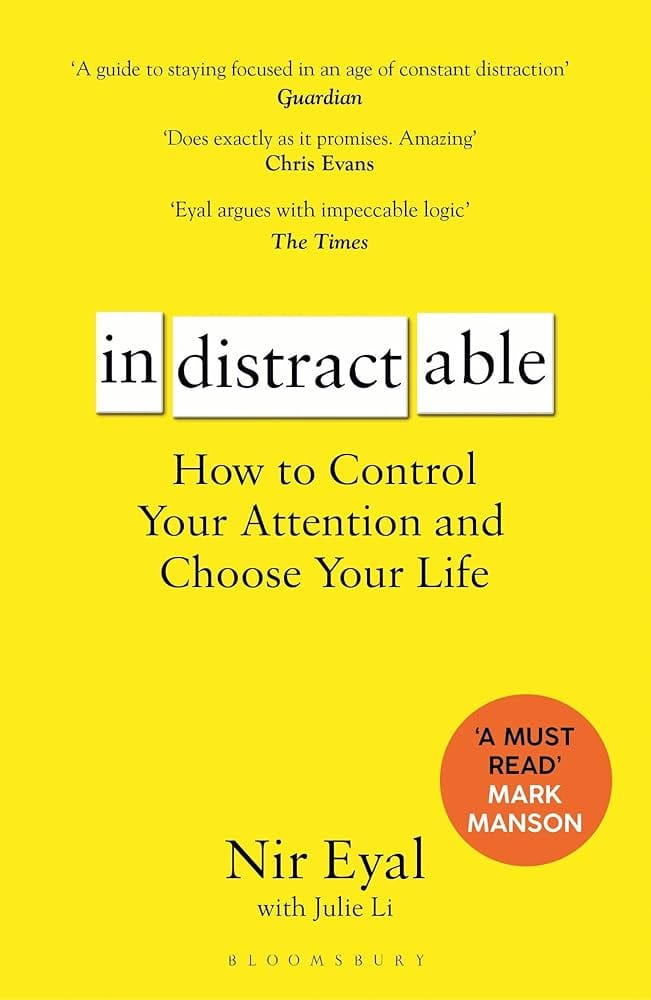
Indistractable - Nir Eyal
Distraction isn’t the enemy, discomfort is. Learn to manage your emotions, design your environment, and make time for traction, and you’ll reclaim focus, self-control, and a life aligned with what matters.

🚀 The Book in 3 Sentences
- Being indistractable simply means doing what I said I’d do, even when it’s uncomfortable.
- Distraction is the opposite of traction; when I make time for traction, life feels meaningful but, when I keep choose distraction, it feels empty.
- Humans are wired to get distracted; instead, notice the urge, sit with it for about 10 minutes, and don’t immediately give in.
🎨 Impressions
The author dives into why we so easily hand over our attention to distractions, and he does it in a surprisingly methodical, human way. We don’t chase distractions because we’re weak—we do it because we’re trying to avoid the discomfort of wanting, effort, or emotional friction. Nir Eyal shares honest stories from both his work life and family life, showing how he actively puts limits around distraction instead of pretending it can be eliminated. He explains that distraction is the opposite of traction, and that intentionally shifting our focus and making real time for traction is what creates a worthy life.
The more effort and time you invest in your own development, the better you get, almost like interest compounding quietly in the background. What I really appreciated is how he breaks the whole distraction problem into simple, achievable steps I can actually use when the urge hits. The most helpful one? Just wait ten minutes before giving in. Often, the urge fades on its own. In the end, a fulfilling life isn’t about eliminating distraction completely—it’s about reducing it, building internal focus, and gaining traction on the things that truly matter.
📀 How I Discovered It
I discovered the book through Ali Abdaal youtube.
🦉 Who Should Read It?
This book is for someone who knows their life is being quietly hijacked by distraction, but isn’t sure how to stop it eventhough they already feel how damaging it is to their well-being. Being constantly pulled away from the gym, from reading, from meaningful work, from family, and from anything that truly matters slowly wears a person down. Over time, that surrender of attention turns into an unfulfilled life, marked by constant anxiety, weakened self-control, and the nagging sense that you’re capable of more, but never quite getting there.
☘️ How the Book Changed Me
- Distraction pulls me away from my goals, while traction is any action that moves me closer to what I want. The real work is managing the triggers that push me toward one or the other.
- Instead of letting boredom run the show, I plan ahead and decide what I’ll do to create traction in my life.
- When a distraction shows up, I use the 10-minute rule: I notice the urge, don’t fight it, and tell myself, “You can have it but just not yet.”
- I picture myself as someone with strong self-control, because how I see myself shapes how I act.
- When distractions happen, I take responsibility for my response instead of blaming the distraction itself.
- Before starting a task, I remind myself why I’m doing it, grounding the action in my own values.
- I use time-boxing by deciding in advance what I’ll do and exactly when I’ll do it.
- I can’t control outcomes, but I can control the time and effort I put into the work.
- Constantly resisting distraction drains mental energy, I make it easier by placing my phone out of sight so I can focus.
- I use pre-commitment by removing future choices altogether, making it harder for impulsive decisions to take over.
✍️ My Top Quotes
- Time management is pain managemement.
- Distraction, it turns out, isn’t about the distraction itself; rather, it’s about how we respond to it.
- The cure for boredom is curiosity.
- You are only powerless if you think you are.
- “The body gets what the body needs.” That subtle mind-set shift took the pressure off by no longer making sleep a requirement.
- Defend your focus.
- What we fear most is usually what we most need to do.
📒 Summary + Notes
- Seeking pleasure is often just our way of trying to escape the pain of wanting something we don’t have yet.
- Distractions usually come from hidden root causes, not from the things distracting us on the surface.
- Dealing with negative urges starts by understanding the discomfort behind them, not by fighting the urge itself.
- We feel motivated to do things because, at some level, we want to move away from discomfort.
- The most sensible way to manage distraction is to learn how to sit with and handle discomfort.
- In the end, distraction is just an alternative strategy our brain uses to cope with pain.
- Willpower isn’t just about brute force; it’s mostly about managing emotions.
- A lack of motivation is temporary, it’s a state, not a permanent trait.
- Label myself as someone with excellent self-control, because identity shapes behavior. When setbacks happen, I respond with self-compassion instead of self-criticism, reinforcing a positive self-image.
- When I struggle with distraction, I take responsibility for my actions without jumping on the guilt train, which only makes things worse and pushes me toward more distraction.
- I remind myself that obstacles aren’t a sign of failure, they’re part of growth.
- People who practice self-compassion tend to be more resilient over time.
- I don’t let other people plan my days. I guard my time before it gets quietly taken away.
- I make time to read, create book notes, go to the gym three times a week, and bullet journal, these are my values.
- I use time-boxing to decide what I’ll do and exactly when I’ll do it.
- If I wake up in the middle of the night and can’t fall back asleep, I take it as a sign that my body has had enough rest and avoid stressing about it.
- I prioritize physical and psychological health so my relationships and work can stay at their best.
- Spending time with friends is an investment in my future health and well-being, so I schedule regular catch-ups instead of leaving them to chance.
- Behavior happens when motivation, ability, and a trigger come together.
- I know I enjoy using my phone, and ignoring it takes effort, so I make it easier on myself by keeping it out of sight.
- External triggers like pings, dings, and rings often pull me into distraction, so I pause and ask: does this serve me, or am I serving it?
- When I attend a meeting, I need to be present both in body and mind. If the meeting isn’t important or worthwhile, it’s better to protect my focus and spend that time on something more meaningful.
- Jumping from one task to another leaves behind attention residue, making it harder to fully focus on what comes next.
- Turn “in-between” moments into learning time such as listening to podcasts or audiobooks during LRT rides, driving, workouts, or walks.
- Rituals build discipline and self-control by turning good intentions into repeatable habits.
- Indistractable organizations create psychological safety, making it easier for people to focus and do their best work.
- Kids can benefit from technology when it’s used in the right way and in the right amount.
- The human psyche needs autonomy, competence, and relatedness. Anxiety and restlessness tend to show up when those above are missing.
- Indistractable partners reclaim time for togetherness.
4 Psychological Factors That Make Satisfaction Temporary
- Boredom: An untrained mind doesn’t enjoy being alone with itself, so it looks for something—anything—to latch onto.
- Negative bias: Bad news and negative events naturally demand more of our attention than positive ones.
- Rumination: We have a habit of replaying unpleasant experiences in our heads, even when they’re no longer useful.
- Hedonic adaptation: No matter what happens—good or bad—we tend to drift back to our usual level of satisfaction over time.
How To Handle Intrusive Thoughts
- Observe the discomfort behind the distraction by turning your attention inward and noticing the real trigger.
- Anxiety.
- Craving.
- Restless, can’t-sit-still feeling.
- Thinking that you’re not good enough.
- Write the trigger down.
- Notice the discomfort and pair it with the distraction it leads to (for example, reaching for your phone).
- Explore the sensation instead of pushing it away.
- Try the “leaves on a stream” exercise: imagine sitting beside a flowing stream, placing each thought on a leaf, and watching it drift away.
- Stay curious about how the sensation feels in your body when distraction is about to take over.
- Is it a flutter of butterflies?
- A racing heart?
- Watch out for liminal moments.
- These are the in-between transitions from one activity to another.
- For example, you open a browser tab, it loads slowly, so you open another “just for a second”—and suddenly half an hour is gone.
Technique To Deal With Distaction Trap
- The ten-minute rule: treat urges like waves, notice the sensation, stay with it, and ride it until it passes.
- When boredom hits and my hand reaches for my phone with nothing useful in mind, I tell myself, “It’s okay to give in but just not yet. I have to wait for ten minutes"
Disarming Uncomfortable Internal Trigger
- Look for emotion that triggers the distraction
- Write down the trigger.
- Explore the negative sensation with curiosity (racing heartbeat)
- be cautious during liminal moments. (Opening ig when waiting for email reply)
- Reimagine our capabilities.
Reimagining Difficult Work As Fun Can Be Empowering And Can Make Us Focused.
- Creativity thrives under constraints. Setting limits—like aiming for a record time—turns effort into something challenging and surprisingly fun.
- Play doesn’t have to feel pleasurable. It just needs to fully capture our attention and pull us into the moment.
How To Be A Good Dad
- I want to be a caring, involved, and fun dad, the kind who’s truly present, not just physically there.
- To make time together more intentional, I’ll have my kid write down activities we can do around town on small strips of paper, drop them into a “fun jar,” and pick one every Friday afternoon to do together.
- I won’t give the people I love most my leftover time. I’ll make time for them on purpose and show up fully.
What Is A Satisfying Friendship?
- Somebody to talk to
- Someone to depend on
- Someone to enjoy
Why Phones Distract Us?
- Humans are drawn to uncertainty, especially when it comes wrapped as potential good or bad news on WhatsApp etc. That unpredictability creates a powerful pull, tempting us to check and quiet the discomfort of anticipation.
Hack My Phone To Gain Focus And Reduce Distaction
- Remove: Delete apps you don’t use anymore. Fewer apps mean fewer temptations.
- Replace: Move certain apps from your phone to your desktop, and use a watch to check the time instead of picking up your phone.
- Rearrange: Organize apps into three simple categories:
- Primary tools: Apps you rely on frequently to get things done, like ride-hailing, banking, and calendars. Ideally fewer than six.
- Aspirations: Apps that support how you want to spend your time, such as Kindle, workout apps, or Blinkist.
- Slot machines: Apps designed to pull you in and make you lose track of time, like Instagram, Facebook, and Twitter.
- Reclaim: Turn off sound notifications and allow only visual alerts, like a small red badge on app icons. Use an hourly chime as a gentle reminder to check in with yourself.
- Read intentionally: Read from books instead of endless web browsing on your phone. Save interesting articles to read later using the Pocket app.
- Clean up feeds: Remove distracting news feeds—tools like DF Tube help strip out the endless scroll and make content more intentional
Example Of Precommitments
- Social pact: Work next to a colleague for a set period of time to stay accountable and focused.
- Price pact: Put money on the line for commitments you make—having something at stake raises the odds you’ll follow through.
- Identity pact: Who we believe we are shapes what we do. Use power phrases like “I am” and “I don’t” instead of “I can’t”—for example, “I am indistractable.”
- “I don’t” aligns with the person I choose to be.
- “I can’t” frames it as a restriction, not an identity
Teaching Kids To Be Indistractable
- What kids need:
- Autonomy: Kids need a sense of choice and control. When adults constantly control their attention, children slowly give up ownership of it.
- Competence: Kids want to feel capable and improving—through mastery, progress, and achievement. If school feels boring, meaningless, or like there’s no chance to get better, it’s no surprise they seek competence elsewhere, like in games.
- Relatedness: Kids want to feel important to others and to know that others matter to them.
- Show kids how you manage your own distractions. Be open about it. When they see you struggle and improve too, trust grows naturally.
- When a child’s psychological needs aren’t met, they often turn to endless screen time or gaming to fill the gap.
- Teach children to make time for traction. Talk openly about your values and theirs, and help them set aside time to become the people they want to be.
- Schedule game time using time-boxing so they know there’s space for fun without it taking over everything.
- Giving kids control over their own time is empowering. They’ll mess up sometimes—and that’s part of learning.
- Schedule family meals together. It’s a simple form of time-boxing that strengthens connection.
- Test for technology readiness by seeing if kids can turn off notifications and manage external triggers.
- Kids need sleep, so avoid placing TVs in their bedrooms.
- Respect their time when they’ve time-boxed it—whether they’re focusing on work or play.
Case Study
- Ask your kids to set their own screen-time limits, like 45 minutes a day or two shows. Before that, gently explain why limiting screen time matters so the idea has time to sink in.
- Follow up by asking how they plan to stick to the limit. Let them suggest solutions themselves, something simple like a kitchen timer often works.
- Remind them that if they can’t keep the promise they made, you’ll need to revisit the agreement together.
- Don’t underestimate your kids’ ability to pre-commit and follow through when they help set the rules and have a clear way to track time.
- Let kids take the lead. When they practice monitoring their own behavior, they slowly learn to manage their time and attention.
- If behavior crosses a line, call it out calmly and address it early, using clear boundaries that prevent it from spreading.