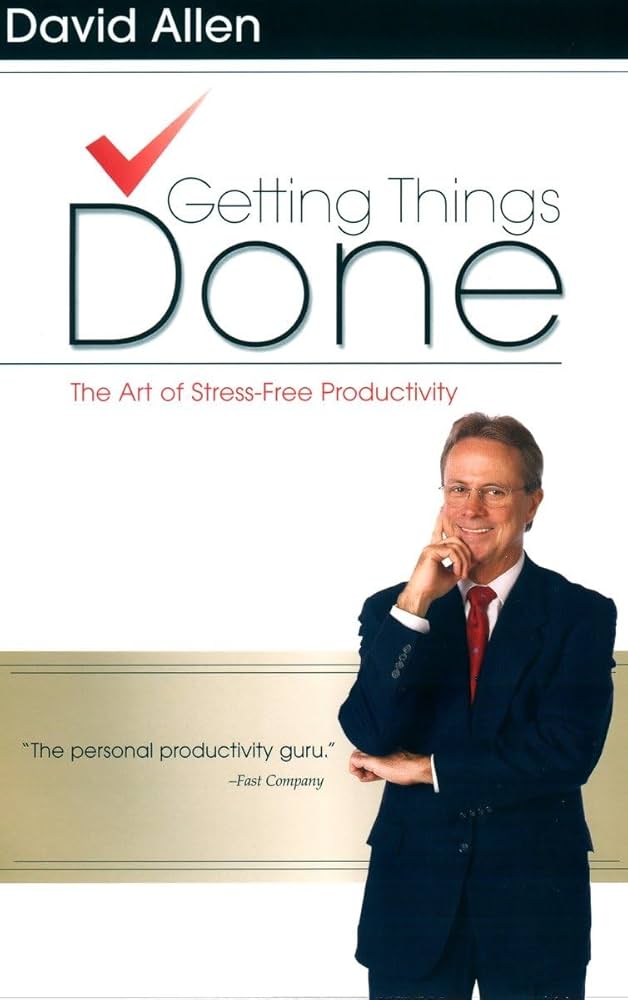
Getting Things Done - David Allen
Capture everything outside your mind, clarify the next action, organize it in trusted systems, review regularly, and act decisively—freeing mental space, reducing stress, and enabling focused, productive work.

🚀 The Book in 3 Sentences
- If it takes two minutes or less, do it immediately.
- Capture every thought the moment it appears—write it down.
- Turn to-do lists into calendar blocks with clear actions and deadlines.
🎨 Impressions
GTD is the original productivity classic. The author lays out practical ways to start projects—and actually finish them. While the book can feel a bit dry, it’s a rare gem among productivity reads. One lesson that stayed with me is the importance of defining a clear, actionable next step after deciding what to do. If a task takes less than two minutes, it’s better to do it immediately—or not at all. Big projects are simply a collection of small steps, and breaking them down into clear, manageable actions makes even intimidating goals achievable. Revisiting and synthesizing the notes will helps reinforce the key principles and makes them easier to apply in daily work. Turning a to-do list into scheduled calendar blocks also boosts productivity by creating a sense of urgency and commitment. More importantly, identifying clear actions reduces anxiety. When you know exactly what needs to be done—and when—you gain a sense of control, the work you are going to do feels far more manageable.
📀 How I Discovered It
Reccomended by goodreads rating and mentioned by Ali Abdaal since he stated that this is the OG book of productivity.
🦉 Who Should Read It?
If you’re overwhelmed by work, this book is worth your time. It may be a little dry, but patient readers will discover some surprisingly valuable gems buried in the discussion.
☘️ How the Book Changed Me
- Anxiety usually shows up when I lack control, organisation, preparation, or clear action. The quickest fix? Focus on what I can control—especially how I choose to respond.
- The book taught me that wishes only turn real when I clearly define the outcome and decide the very next physical action.
- Most of the time, it’s not a lack of time—it’s a lack of clarity about what the next action actually is.
- Projects don’t need fancy prioritisation. They just need regular reviews and at least one clear next action. You don’t do projects—you do actions.
- I’ve stopped worshipping long to-do lists and now put just three things on my calendar. The calendar is sacred; if it’s there, it gets done.
- Time-specific actions
- Day-specific actions
- Day-specific information
- Amazing things happen when I clearly picture the final outcome. The clearer the picture, the stronger the motivation.
- I realised I need a second home office that mirrors my real office. Same setup, same focus—whether I’m at home, at work, or on the move. My iPad mini is basically my portable workspace.
- Capturing open loops should be quick, easy, and even a little fun. If it feels heavy, I won’t do it.
- Deciding isn’t an action. Actions take time. Decisions just clear the path.
- When my energy dips, the fastest way to recharge is closing a few open loops—especially easy ones. Small wins = instant momentum.
- Being organised means I can take advantage of random, unexpected time windows instead of wasting them.
- I’ve learned that my career will stagnate if I don’t clearly state my goals to my boss. No one else is going to do that for me.
- I want my mind to think about things, not to store them. My goal is to add value to my projects, not to act as my own reminder app.
- Having a personal “inbox” with colleagues—or even with my wife—helps avoid constant interruptions while keeping communication flowing.
- Every meeting should end with a clear way forward: a specific action, assigned to a specific person. Otherwise, it’s just a nice conversation.
✍️ My Top Quotes
- The task is not given, it has to be determined
- The beginning is half of every action.
- Vision is not enough; it must be combined with venture.
- Everything should be made as simple as possible, but not simpler
- You’ve got to think about the big things while you’re doing small things, so that all the small things go in the right direction.
- Simple, clear purpose and principles give rise to complex and intelligent behavior. Complex rules and regulations give rise to simple and stupid behavior.
- You won’t see how to do it until you see yourself doing it.
- Those who make the worst use of their time are the first to complain of its shortness.
- Your best thoughts about work won’t happen while you’re at work.
- The middle of every successful project looks like a disaster.
- Let our advance worrying become advance thinking and planning.
- The sense of anxiety and guilt doesn’t come from having too much to do. It’s the automatic result of breaking agreements with yourself.
- The secret of getting ahead is getting started. The secret of getting started is breaking your complex overwhelming tasks into small manageable tasks, and then starting on the first one.
- A vision without a task is but a dream, a task without a vision is drudgery, a vision and a task is the hope of the world.
📒 Summary + Notes
- I’ve learned to capture everything I need to do—now, later, someday, or somewhere in between—outside my head. My mind is for thinking, not for storage.
- Discipline starts at the front door: decide early whether to ignore it, delegate it, park it, or do it now. Undecided things are where stress quietly breeds.
- Working from almost anywhere is totally possible—as long as I have a compact system and can process things quickly and on the go.
- A work funnel only works when I process items one at a time, in order. Cherry-picking what I feel like doing just creates backlog. Decide what’s in the inbox, where it goes, and never put it back.
- The ability to walk around with a truly empty mind comes from knowing every action is captured, clearly defined, and safe to wait. Recalling them should take seconds, not days.
- Guilt, frustration, and anxiety usually come from broken agreements with myself. I say I’ll do something, I don’t do it—and trust erodes quietly.
- Getting things out of my head and onto a system lets me renegotiate those agreements in real time. It gives me the space to think—and act—clearly.
- Ironically, bright people procrastinate the most because they carry too many undecided things. The nervous system can’t tell the difference between thoughts and reality, so creative minds tend to run worst-case scenarios on repeat.
- Intelligently dumb things down by defining the very next action. Clarity beats cleverness every time.
- Action lists grow back when procrastination sneaks in—even if everything is written down. Writing is step one; deciding is step two.
- Defining the next action forces clarity, accountability, productivity, and a surprising sense of empowerment.
- Long-term projects aren’t “someday/maybe” ideas. They’re just a series of next actions waiting to be done.
- And finally, complaining is often a signal that someone isn’t willing to change a situation that’s actually malleable. If it can be changed, act. If it can’t, accept—and move on.
Managing commitments (aka keeping promises to myself)
- Capture everything unfinished into a trusted collection bucket. If it’s unfinished, it doesn’t belong in my head.
- Clarify what it is and decide what to do with it—no vague “I’ll think about it later.”
- Keep reminders in an organised system that I actually review, not one I hope to remember.
Making the collection phase actually work
- Every open loop must live in the system, not in my mind.
- Fewer collection buckets are better—simple beats fancy.
- Empty them regularly, or they turn into emotional junk drawers.
When there is NO action
- Trash it.
- Incubate it (someday/maybe).
- File it as reference.
When there IS action
- Do it now if it takes less than two minutes.
- Delegate it if someone else should handle it.
- Defer it and track it clearly as a next action.
Tracking actions without losing sanity
- Put it on the calendar, or
- Add it to a next-action list, or
- Put it on a waiting-for list.(No action lives nowhere.)
Why daily to-do lists usually fail
- New inputs constantly reshuffle priorities throughout the day.
- Tasks that don’t need to be done today dilute focus from the ones that truly do.
The 4-criteria model for choosing what to do
right now
- Context: Where am I?
- Time available: How much time do I actually have?
- Energy available: Brain power or zombie mode?
- Priority: What really matters most?
Priorities from six different altitudes
- 50,000 ft: Life purpose and how it shows up.
- 40,000 ft: 3–5 year vision (including personal net worth).
- 30,000 ft: 1–2 year goals.
- 20,000 ft: Areas of responsibility.
- 10,000 ft: Current projects.
- Runway: The next physical actions.
The ingredients of relaxed control
- Clearly defined outcomes with obvious next actions.
- Reminders stored in a trusted system that gets reviewed regularly.
Five steps to getting anything done
- Define purpose and principles: purpose gives energy and direction; principles guide behaviour.
- Visualise the outcome clearly.
- Brainstorm freely.
- Organise the pieces.
- Identify the very next action.
My clear picture of success
Work
- Looks like: I own a company.
- Sounds like: relaxed, reassured, gritty.
- Feels like: confident in unknown territory.
Business
- Looks like: USD 1 million in clean profit every month, consistently, until age 65.
- Sounds like: interesting, brutally hard, gritty.
- Feels like: security for my family and immediate community.
Vision, principles, and purpose—simplified
- Vision: the actual blueprint of the result.
- Principles: reference points for excellent conduct.
- Purpose: the juice and direction.
Who I want to be (my definition of “somebody”)
- Trader
- Investor
- Guitarist
- Fitness junkie
- Entrepreneur
- Reader
- Website owner
Three basic steps to developing a vision (CEO mindset)
- Look beyond completion: imagine the project already finished.
- Envision wild success: IPO, USD 500 million valuation.
- Capture what you see:
- Features: every coffee place in Malaysia on one website.
- Aspects: best coffee delivery, especially hot Americano.
- Qualities: the ultimate one-stop coffee hub in Malaysia.
How to stay productive and creative
- Collect all open loops.
- Apply clear front-end thinking.
- Manage results through organisation, regular reviews, and action.
And finally…
- There are really only two problems in life.(…and everything else is just a poorly defined next action.)